If your mortgage application was denied, start with the adverse action notice your lender is required to send you. It names the specific reason you were turned down, and that reason is your recovery plan. Fix what the lender actually cited, whether that is credit, debt-to-income ratio, savings, income documentation, or the property itself, then reapply once you have hit the benchmarks. There is no mandatory waiting period after a mortgage denial.
A denial is a detour, not a dead end. Every year, hundreds of thousands of borrowers recover from a denial and go on to close on a home. The difference between the people who get there and the people who give up is a clear plan.
This guide is that plan. It covers exactly why mortgages get denied, what to do based on your specific denial reason, what to do if you were denied late in the process, realistic timelines for recovery, and where to get free help.
Your First 48 Hours After a Mortgage Denial
Work this checklist before you do anything else:
- Read your adverse action notice. Federal law requires your lender to send it, and it lists the specific reason or reasons your application was denied. This is the single most important document in your recovery.
- Call your loan officer and ask for numbers. Ask directly: "What specific metrics would I need to hit to be approved?" You want a target credit score, a maximum DTI ratio, or a minimum down payment and reserve amount. Those numbers become your recovery goals.
- Pull all three credit reports. Get them free at AnnualCreditReport.com. Mortgage lenders use your middle score, so you need Equifax, Experian, and TransUnion, not just one.
- Do not apply anywhere else yet. Reapplying before you have fixed the underlying issue usually produces a second denial plus another hard inquiry. Diagnose first, then apply.
- Write down your starting numbers. Current middle credit score, current DTI, current savings. You cannot measure progress against a number you never recorded.
If your denial letter is vague, you have the right to request more detail about the decision. Ask for it in writing.
Why Mortgages Get Denied (And What Your Denial Letter Actually Means)
When a lender denies your mortgage application, they are required by federal law (the Equal Credit Opportunity Act, implemented through Regulation B) to send you an adverse action notice within 30 days. This letter tells you exactly what went wrong.
Do not ignore it. Do not throw it away in frustration. Read it carefully, because your entire recovery plan starts here.
The Top 5 Reasons Mortgages Get Denied
According to Home Mortgage Disclosure Act (HMDA) data, these are the most common denial reasons:
| Denial Reason | Approx. % of Denials | What It Means |
|---|---|---|
| Credit history | ~30% | Score too low, derogatory marks, thin credit file, or recent negative items |
| Debt-to-income ratio (DTI) | ~25% | Monthly debt payments are too high relative to income |
| Insufficient cash / down payment | ~15% | Not enough savings for down payment, closing costs, or reserves |
| Employment / income | ~15% | Income too low, unstable employment, or documentation gaps |
| Property / collateral | ~10% | Appraisal issues, title problems, or property condition concerns |
The good news: four of the five top denial reasons are things you can actively improve. Only property or collateral issues are largely outside your control, and even then there are strategies.

How to Read Your Adverse Action Notice
Your denial letter should include:
- The specific reason or reasons for denial (lenders must list at least one)
- Your credit score used in the decision and which bureau provided it
- The credit bureau's contact information so you can request your free report
- Your right to request more details about the denial within 60 days
Action step: If your letter is vague, call your loan officer directly. Ask: "What specific metrics would I need to hit to be approved?" Get exact numbers: a target credit score, maximum DTI ratio, or minimum down payment amount. These become your recovery goals.
Recovery Roadmap by Denial Reason
This is the core of your recovery plan. Find your denial reason below and follow the specific roadmap for your situation.
Denied for Low Credit Score: Recovery Plan
A credit-related denial is the most common, and it is also the most fixable. Here is how to systematically rebuild.
Step 1: Get all three credit reports (Week 1)
Request your free reports from AnnualCreditReport.com. You need all three (Equifax, Experian, TransUnion) because mortgage lenders use your middle score. Studies show that roughly 1 in 5 consumers have an error on at least one report, errors that could be dragging your score down unnecessarily.
Step 2: Dispute any errors (Weeks 1 to 4)
If you find inaccuracies, such as wrong balances, accounts that are not yours, or late payments that were actually on time, dispute them directly with each bureau. Successful disputes can boost your score quickly, sometimes within 30 days.
Step 3: Pay down credit card balances (Months 1 to 3)
Credit utilization (how much of your available credit you are using) accounts for roughly 30% of your score. The fastest way to improve your score:
- Get every card below 30% utilization (good)
- Get every card below 10% utilization (excellent)
- If you can only pay down one card, start with the one that has the highest utilization percentage, not the highest balance
Step 4: Address derogatory marks
Collections, charge-offs, and late payments all drag down your score. Depending on the situation:
- Collections under $500: Some newer scoring models (FICO 9, VantageScore 3.0) ignore paid collections. Pay them and note which scoring model your lender uses.
- Late payments: If it was a one-time mistake, try a goodwill letter asking the creditor to remove it.
- Older derogatory marks: Items older than 2 years have diminishing impact. Focus your energy on recent items.
Step 5: Do not open new credit (entire recovery period)
Every new application creates a hard inquiry (a small short-term ding) and lowers your average account age. Avoid new credit cards, auto loans, or store financing until after your mortgage closes.
Typical timeline: Most borrowers who follow a structured credit improvement plan see meaningful score improvements within 3 to 6 months. Moving from a 580 to 620 (FHA-qualifying to conventional-qualifying) typically takes 3 to 4 months with consistent effort. It is also worth understanding how the 2026 credit score changes affect denial recovery, since the transition to FICO 10T may shift which factors matter most.
Related guide: How to Improve Your Credit Scores Before Applying for a Mortgage, a detailed, step-by-step credit improvement playbook.
Denied for High DTI: Recovery Plan
Your debt-to-income ratio compares your total monthly debt payments to your gross monthly income. Most lenders want to see:
- FHA loans: DTI at or below 43% (some flexibility up to 50% with compensating factors)
- Conventional loans: DTI at or below 45% (some up to 50%)
- VA loans: No hard DTI cap, but 41% is the guideline
If your DTI is too high, you have two levers: reduce debt payments or increase income.
Reduce debt payments (faster path):
- List every monthly debt payment: credit cards, auto loans, student loans, personal loans, child support, alimony
- Target the debts with the smallest balances. Eliminating a $150/month car payment drops your DTI more effectively than paying down a fraction of your student loans
- Consider consolidation carefully. A personal loan to pay off multiple credit cards can lower your DTI if the new payment is less than the combined minimums
- Do NOT close credit cards after paying them off, since this hurts your credit utilization ratio
Increase income (longer path but powerful):
- Document side income (must typically be sustained for 2 or more years to count)
- Ask for a raise or seek higher-paying employment
- If self-employed, work with your CPA to maximize documentable income on tax returns (some self-employed borrowers over-deduct, which lowers their qualifying income)
The student loan factor: If student loans are a major contributor to your DTI, you have options. Income-driven repayment (IDR) plans can lower your monthly payment, and some lenders use the IDR payment rather than the standard payment for DTI calculations. Read our complete guide to student loans and mortgage qualification.
Related guide: The Ultimate Guide to DTI Optimization for Mortgage Approval, strategies to lower your ratio methodically.
Denied for Insufficient Down Payment: Recovery Plan
Lenders want to see that you have enough cash for three things:
- The down payment itself (3% to 20% depending on loan type)
- Closing costs (typically 2% to 5% of the loan amount, see our guide to understanding unexpected closing costs)
- Cash reserves (some loans require 2 to 6 months of mortgage payments in savings after closing)
If you were denied for insufficient funds, here is your plan:
Explore down payment assistance (DPA) programs first
This is the fastest fix. Over 2,000 DPA programs exist across the U.S., offering grants, forgivable loans, or matched savings. Many first-time buyers qualify and do not know these programs exist. Start with your state's housing finance agency, then ask your loan officer about local options. Our guide to down payment assistance programs for first-time homebuyers walks through how they work and who qualifies.
Build your savings systematically
- Set up automatic transfers on payday. Even $200/month adds up to $2,400 in a year
- Open a separate high-yield savings account specifically for your home fund (keeping it separate makes it easier to track and harder to spend)
- Redirect windfalls, including tax refunds, bonuses, and gifts, directly to your home fund
Gift funds
FHA, VA, and most conventional loans allow gift funds from family members for the down payment. The key requirement: the gift must be documented with a gift letter stating it is not a loan and does not require repayment.
Choose the right loan program
Different programs have dramatically different down payment requirements:
| Loan Type | Minimum Down Payment |
|---|---|
| VA loan | 0% (eligible veterans and military) |
| USDA loan | 0% (eligible rural areas) |
| FHA loan | 3.5% (580+ credit score) |
| Conventional (first-time programs) | 3% (HomeReady, Home Possible) |
| Conventional (standard) | 5% to 20% |
Related guide: Building Emergency Savings Before Buying a Home, practical strategies for building your financial foundation.
Denied for Employment or Income Issues: Recovery Plan
Income-related denials typically fall into three buckets:
1. Income too low for the requested loan amount
- Consider a less expensive property
- Look into shared-equity or co-borrower arrangements
- Increase your down payment to reduce the loan amount needed
2. Unstable employment history
- Most lenders want to see 2 years of consistent employment in the same field
- Job changes are fine if they are in the same industry and show upward progression
- Gaps longer than 30 days need a written explanation
3. Self-employment documentation issues
- Lenders typically need 2 years of tax returns, including all schedules
- Your qualifying income is your net income after business deductions, not your gross revenue
- Work with your CPA to balance tax minimization with mortgage qualification (sometimes reducing deductions by a small amount can significantly increase qualifying income)
Related guide: Self-Employed Client Documentation: Streamlining the Process, how to prepare your documentation package.
Denied for Property Issues: What You Can Control
Property-related denials are different because the issue is not you, it is the home. Common problems include:
- Low appraisal: the home appraised below the purchase price
- Property condition: health or safety issues, structural problems, or code violations
- Title issues: liens, boundary disputes, or ownership questions
What you can do:
- Low appraisal: Negotiate a lower price with the seller, bring more cash to closing, or request a reconsideration of value with comparable sales the appraiser may have missed
- Property condition: Ask the seller to make repairs before closing, or look at a different property
- Title issues: These typically require a title attorney to resolve, and your real estate agent can guide you
The silver lining: a property denial does not reflect on your financial readiness at all. You may qualify immediately for a different property.
Denied Late in the Process: After Pre-Approval, in Underwriting, or Before Closing
Late-stage denials are the most painful kind, because you have already picked a house and told everyone. They also have the clearest fix, because the trigger is usually one specific, identifiable change.
Denied After Pre-Approval
A pre-approval is not a loan. It is a conditional assessment based on a snapshot of your file at one moment in time. Between pre-approval and closing, the lender re-verifies almost everything.
Common reasons a pre-approved buyer gets denied:
- New debt. A car loan, a furniture financing plan, or a new credit card raises your DTI and can push you past the limit
- A credit score drop. A missed payment or a jump in card balances between pre-approval and underwriting
- A job or pay-structure change. Switching from salary to commission, going self-employed, or changing industries can reset the income history a lender needs
- Undisclosed debts that appear on the refreshed credit report
- A higher purchase price than the pre-approval was calculated for
Denied During Underwriting
Underwriting is where a human (and an automated system) actually tests your file. Denials here usually trace to conditions that were never satisfied:
- Missing or inconsistent documentation. Pay stubs, tax returns, and bank statements that do not reconcile
- Large undocumented deposits. Underwriters must source any deposit that is not obviously payroll. A cash gift needs a gift letter
- Income that does not calculate the way you expected. Bonus, overtime, and self-employment income are averaged and often discounted
- Appraisal below the contract price, which changes the loan-to-value ratio the approval was based on
- Property or insurance problems, including flood zone requirements or an uninsurable condition
Denied Before or At Closing
Many lenders run a final credit refresh and re-verify employment in the days right before closing. That is when late denials happen.
Protect the file in the final stretch:
- Do not open new credit accounts or finance anything, including appliances and furniture, until after closing
- Do not make large purchases or move money between accounts without a paper trail
- Do not change jobs, quit, or shift to contract work
- Keep paying every bill on time, and keep card balances flat
- Answer your loan officer's document requests the same day
What to Do After a Late-Stage Denial
The recovery logic is the same as any other denial, just compressed:
- Get the adverse action notice. ECOA applies at every stage. The lender must tell you the specific reason
- Ask whether the file can be cured rather than restarted. If the trigger was a single undocumented deposit or a missing letter of explanation, the fix may take days, not months
- Ask about a different program. A file that fails conventional underwriting sometimes clears FHA guidelines with the same numbers
- Talk to your real estate agent about the contract. Financing contingencies and earnest money deadlines are contract questions, not lending questions. UQUAL does not provide legal advice, so bring contract terms to your agent or your attorney
- Then work the same per-reason roadmap above for whatever the notice actually cited
Free Help That Costs Nothing
You do not have to pay anyone to recover from a denial.
HUD-approved housing counselors. HUD approves nonprofit agencies that provide homebuyer counseling, and their services are free or low cost. A counselor can go through your adverse action notice with you, build a household budget, and explain which programs fit your situation. Find one through HUD's official housing counselor search. Use HUD's own directory rather than a paid referral service, and be skeptical of any company that charges an upfront fee to "fix" a denial.
Your state housing finance agency. Every state has one, and it administers down payment assistance, closing cost help, and first-time buyer programs. Start there before assuming you cannot afford the down payment. See our guide to down payment assistance programs.
Your own lender. Ask the loan officer who denied you what would need to change. Most will tell you, and it costs nothing.
How Long Until I Can Reapply?
This is one of the most common questions after a denial, and the answer depends entirely on your denial reason and how quickly you address it.
Reapplication Timeline by Denial Reason
| Denial Reason | Typical Recovery Time | Fastest Possible | What Determines Speed |
|---|---|---|---|
| Credit score (minor issues) | 2 to 4 months | 30 days | Utilization reduction, error disputes |
| Credit score (major issues) | 6 to 12 months | 3 months | Derogatory mark age, rebuilding consistency |
| High DTI | 2 to 6 months | 1 month | How quickly debts can be paid down |
| Insufficient savings | 3 to 12 months | 1 month (with gift funds or DPA) | Savings rate, DPA availability |
| Employment or income | 6 to 24 months | 3 months | Type of issue (gap vs. documentation) |
| Property issues | Immediate | Immediate | Finding a qualifying property |
Important: There Is No Mandatory Waiting Period
Unlike some financial events (bankruptcy, for example, which requires 1 to 4 years before FHA eligibility), a standard mortgage denial has no mandatory waiting period. You can technically reapply the next day with a different lender.
That does not mean you should. Reapplying without addressing the underlying issue will likely result in another denial, plus another hard inquiry on your credit report.
The smart approach: Use the timelines above to set realistic goals, address your specific denial reason, then reapply when you have met the lender's benchmarks.
The 30-Day, 90-Day, and 6-Month Recovery Timeline
No matter your denial reason, here is a phased approach to get back on track.

First 30 Days: Build Your Foundation
- Read your adverse action notice thoroughly and identify every reason listed
- Call your loan officer and ask for specific benchmarks you would need to meet
- Pull all three credit reports from AnnualCreditReport.com
- Dispute any errors on your credit reports
- Create a financial snapshot: current credit score, DTI ratio, savings balance
- Set specific, numbered goals: target credit score, target DTI, target savings amount
- Research down payment assistance programs in your state
- Book a free HUD-approved housing counseling session if you want a second set of eyes on the file
- Start a dedicated home fund savings account
This first month is about understanding exactly where you are and where you need to be. No guessing, real numbers.
Days 30 to 90: Active Improvement
- Pay down highest-utilization credit cards to below 30%
- Make every payment on time. Set up autopay for at least the minimum on everything
- Pay off one small debt entirely if possible (eliminates a monthly payment, lowers DTI)
- Save aggressively. Automate transfers, reduce discretionary spending
- Avoid new credit applications. No new cards, no financing furniture
- Document income stability. Keep pay stubs, bank statements, and tax documents organized
- Get pre-qualified (soft pull, not hard pull) to check progress
By the 90-day mark, you should see measurable improvement. Credit scores typically reflect utilization changes within 30 to 60 days of balance reductions.
Months 3 to 6: Position for Approval
- Re-check your credit scores. Are you at or above your target?
- Recalculate your DTI. Has it dropped to the lender's threshold?
- Verify your savings. Do you have enough for down payment, closing costs, and reserves?
- Get formally pre-approved with a lender (this involves a hard credit pull)
- Consider multiple lenders. Different lenders have different overlays and flexibility
- Lock in your rate when you find the right property
When to Reapply
Reapply when you have objectively met the benchmarks your previous lender identified. Understanding how long the underwriting process takes helps you set realistic expectations for what comes after reapplication. If your denial letter said "credit score below 620" and you are now at 635, you are ready. If it said "DTI of 52%" and you have dropped to 42%, you are ready.
Do not guess. Know.
Exploring Alternative Loan Programs
Sometimes the fastest path to approval is not fixing the issue, it is finding a program that works with your current situation.
FHA Loans
FHA loans are designed for borrowers who do not fit the conventional mold. Key advantages:
- Credit scores as low as 500 (with 10% down) or 580 (with 3.5% down)
- DTI ratios up to 50% with compensating factors
- More lenient on past credit issues (collections, charge-offs)
- Available just 2 years after a bankruptcy discharge
If you were denied for a conventional loan, an FHA loan may be your fastest path. Read our comparison of FHA vs. conventional loans.
VA Loans
For eligible veterans and active-duty military:
- No down payment required
- No PMI (private mortgage insurance)
- No official minimum credit score (though most lenders set 580 to 620)
- More flexible DTI guidelines
USDA Loans
For properties in eligible rural and suburban areas:
- No down payment required
- Competitive interest rates
- Income limits apply (typically 115% of area median income)
- Credit score minimum usually 640
Credit Unions and Community Banks
Smaller institutions often have more flexibility than large national lenders. They may:
- Offer portfolio loans with custom underwriting
- Consider non-traditional credit history
- Provide manual underwriting that looks beyond automated scores
- Have lower overlay requirements than big banks
Non-QM Lenders
Non-qualified mortgage lenders serve borrowers who do not fit standard underwriting boxes:
- Bank statement loans for self-employed borrowers
- Asset-depletion loans for borrowers with savings but low income
- Recent credit event loans for borrowers with a past bankruptcy or foreclosure
These come with higher rates but can be a bridge to homeownership while you continue improving your financial profile.
One Clarification: Readiness Is Not the HomeReady Loan
Mortgage readiness is not the Fannie Mae HomeReady loan or the Freddie Mac Home Possible program. Those are specific low-down-payment conventional products with their own income and eligibility rules. Readiness is the state of qualifying for any of them. If a lender or a search result points you toward HomeReady or Home Possible, that is a product recommendation, not an assessment of whether your file is ready.
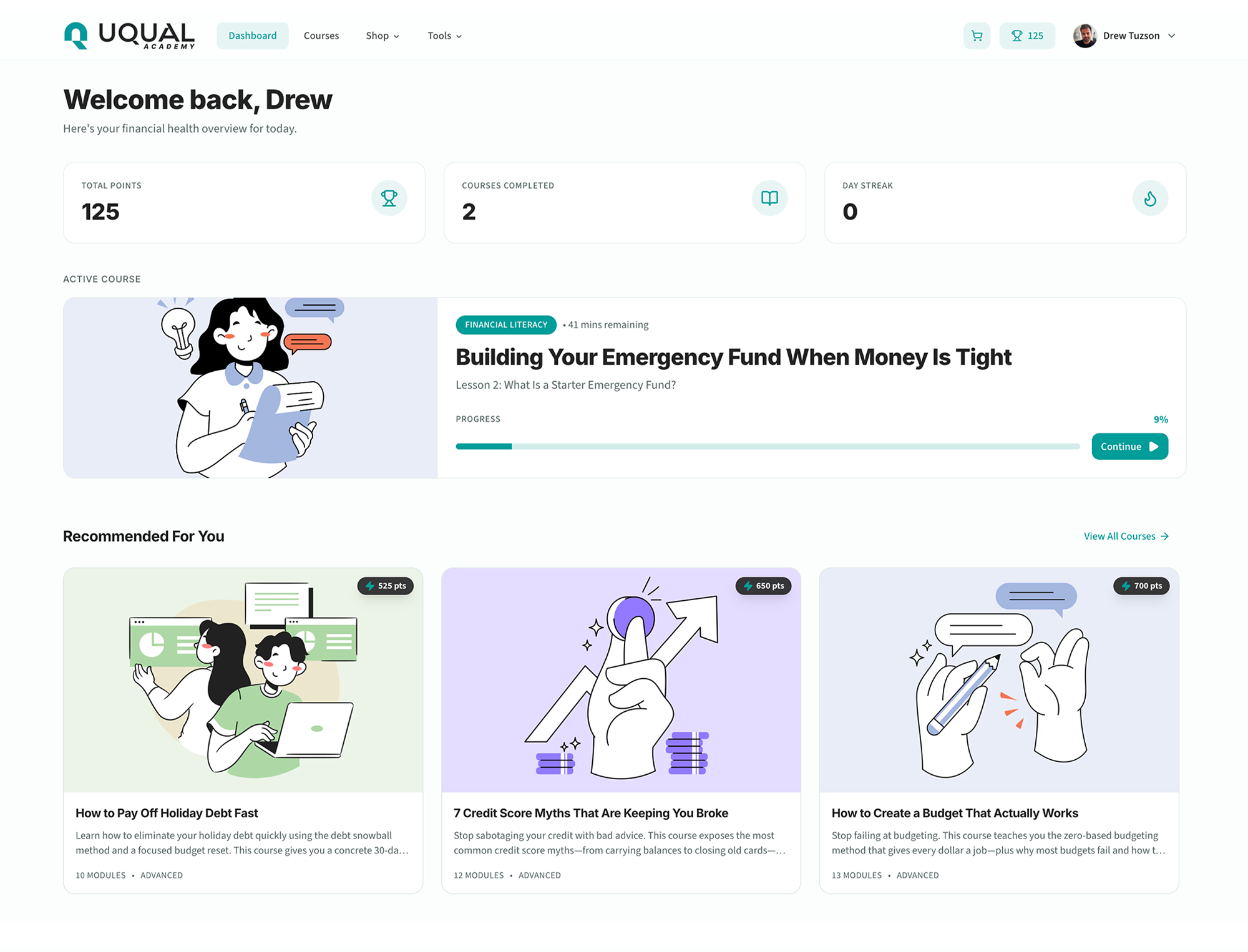
How UQUAL Helps You Go From Denied to Approved
Recovering from a mortgage denial on your own is absolutely possible. Having a structured system makes it faster and more predictable.

UQUAL's Loan Readiness Academy is built specifically for this situation. The platform addresses all four pillars that determine mortgage qualification:
| What You're Facing | How UQUAL Helps |
|---|---|
| Low credit score | Personalized credit improvement action plans |
| High DTI | Debt prioritization strategies tailored to mortgage qualification |
| Insufficient savings | Savings goal tracking with milestone rewards |
| Documentation gaps | Pre-application document checklists and preparation guides |
The Loan Readiness Score
Unlike a credit score, which only measures one dimension of your financial health, UQUAL's Loan Readiness Score evaluates all four factors that mortgage underwriters assess. This gives you a realistic picture of where you actually stand, not just where your credit report says you stand.
Free Courses, Real Progress
Every UQUAL course is free and designed to produce measurable results:
- Credit foundations: understand what is on your report and how to improve it
- DTI mastery: strategies to reduce your ratio systematically
- Savings accelerator: build your down payment fund with proven methods
- Pre-approval prep: get your documentation ready before you apply
The key difference between UQUAL and generic financial advice: loan readiness is not credit repair. It is a comprehensive approach to mortgage qualification that addresses everything underwriters evaluate, not just your score.
UQUAL is a loan readiness company. UQUAL is not a credit repair company and does not provide credit repair, debt settlement, legal, or tax guidance, and UQUAL is not a lender.
Start your recovery plan today
FAQ: Mortgage Denial Recovery
What should I do immediately after being denied for a mortgage?
Read your adverse action notice carefully to identify the specific reason or reasons for denial. Then call your loan officer within 48 hours and ask for the exact benchmarks you would need to meet for approval. Pull your credit reports from AnnualCreditReport.com and create a clear picture of your current financial standing. The worst thing you can do is nothing. A denial is actionable feedback, not a permanent verdict.
Can you get denied a mortgage after being pre-approved?
Yes. A pre-approval is a conditional assessment based on your file at one point in time, not a commitment to lend. Before funding, the lender re-verifies your credit, employment, income, and assets. The most common reasons a pre-approved buyer is later denied are new debt or a new credit application, a drop in credit score, a job or pay-structure change, undisclosed debts that surface on the refreshed report, and a purchase price higher than the pre-approval assumed.
Why do mortgages get denied during underwriting?
Underwriting denials usually trace back to conditions that were never satisfied: missing or inconsistent documentation, large deposits the underwriter cannot source, income that calculates lower than expected once bonus or self-employment income is averaged, an appraisal below the contract price, or property and insurance problems. Many of these are curable within days if you respond quickly to the lender's document requests.
Can a mortgage be denied at closing?
Yes. Many lenders run a final credit refresh and re-verify employment in the days right before closing, so a new credit account, a large purchase, a missed payment, or a job change in that window can stop the loan. Protect the file by making no new credit applications, no large purchases, and no job changes until after closing. If the loan is denied at that stage, you are still entitled to an adverse action notice naming the reason, and contract questions about your financing contingency should go to your real estate agent or attorney.
Should I talk to a HUD-approved housing counselor after a mortgage denial?
It is usually worth it, and it is free or low cost. HUD-approved housing counseling agencies are approved by the U.S. Department of Housing and Urban Development, and a counselor can review your denial letter, your budget, and your credit with you, then point you toward programs you may qualify for. Find an agency through HUD's official housing counselor search rather than a paid referral service, and avoid any company that charges an upfront fee to reverse a denial.
Can I reapply for a mortgage after being denied?
Yes, there is no legal waiting period after a mortgage denial. You can technically reapply the next day. However, reapplying without fixing the underlying issue will likely result in another denial and another hard inquiry on your credit. The smart approach is to address the specific reason for denial, then reapply once you have met the lender's benchmarks.
How long after a mortgage denial should I wait to reapply?
It depends on your denial reason. Credit utilization issues can be resolved in 1 to 3 months. Credit score rebuilding typically takes 3 to 6 months. DTI improvements take 2 to 6 months depending on how quickly you can pay down debt. Savings shortfalls take 3 to 12 months depending on your savings rate and whether you qualify for down payment assistance. Do not set an arbitrary waiting period. Reapply when you have objectively met the requirements.
Will a mortgage denial hurt my credit score?
The denial itself does not appear on your credit report or directly affect your score. However, the hard credit inquiry from the mortgage application may temporarily lower your score by a few points (typically 5 to 10). Multiple mortgage inquiries within a 14 to 45 day window (depending on the scoring model) are treated as a single inquiry, so shopping multiple lenders quickly minimizes the impact.
What are the most common reasons for mortgage denial?
The five most common reasons are credit history issues (about 30% of denials), high debt-to-income ratio (about 25%), insufficient cash for down payment and closing costs (about 15%), employment or income problems (about 15%), and property or collateral issues (about 10%). Most of these are fixable with a targeted recovery plan.
Can I apply with a different lender after being denied?
Absolutely. Different lenders have different underwriting standards, credit overlays, and loan programs. A borrower denied by one lender might be approved by another, especially if you apply for a different loan type (FHA instead of conventional, for example) or work with a lender that has more flexibility for your specific situation. Just make sure to apply within the same 14 to 45 day rate shopping window to minimize credit inquiry impact.
How do I fix my debt-to-income ratio after a mortgage denial?
Focus on eliminating monthly payments rather than just reducing balances. Paying off a $3,000 credit card that requires a $90/month minimum drops your DTI immediately. Prioritize debts with the smallest payoff amounts for the fastest DTI improvement. On the income side, document any raises, bonuses, or side income (though side income typically needs a 2-year history to count). See our complete DTI optimization guide for detailed strategies.
What credit score do I need to get approved for a mortgage?
Minimum credit score requirements vary by loan type: FHA loans require 500 (with 10% down) or 580 (with 3.5% down), VA loans have no official minimum (but most lenders require 580 to 620), conventional loans require 620 or higher, and USDA loans typically require 640 or higher. Higher scores unlock better interest rates and terms. See our guide to credit score requirements for every mortgage type and our guide for first-time buyers.
Is it better to wait and save a larger down payment or apply sooner?
It depends on your housing market and financial situation. Waiting to save more means lower monthly payments and possibly no PMI, but it also means potentially higher home prices and interest rates. Many first-time buyers do not realize they can qualify with as little as 3% down (conventional) or 3.5% (FHA), and down payment assistance programs can cover some or all of that amount. Calculate both scenarios to see which makes more financial sense for you.
How does UQUAL help after a mortgage denial?
UQUAL's Loan Readiness Academy provides free courses and tools specifically designed to help denied borrowers recover. The platform evaluates your readiness across all four pillars that mortgage underwriters assess, including credit health, debt-to-income ratio, down payment savings, and financial documentation, giving you a comprehensive recovery plan rather than just a credit score to chase. Learn more about what loan readiness means and how it differs from credit repair.
UQUAL Editorial Team
Financial Education Team
The UQUAL Editorial Team creates educational content to help aspiring homeowners become loan-ready through financial literacy, credit building, and mortgage preparation.