You can qualify for a mortgage with a credit score between 500 and 620 by matching your middle mortgage FICO score to the right loan program, such as an FHA loan at 580 with 3.5% down or 500 to 579 with 10% down, and strengthening your debt-to-income ratio, cash reserves, and documentation before applying. Underwriters evaluate all four loan readiness pillars together.
When borrowers search for how to get a mortgage with bad credit, or ask how to buy a house when their credit profile has past blemishes, most advice online stops at surface-level credit score tips. In actual mortgage underwriting, a credit score between 500 and 620 is rarely evaluated in isolation. Instead, automated underwriting systems and human underwriters weigh your credit profile against three additional risk pillars: your monthly debt-to-income ratio (DTI), your verified down payment and post-closing cash reserves, and the stability of your employment and financial documentation.
This 2026 roadmap breaks down the exact federal agency rules for borrowers in the 500 to 620 credit band, the official U.S. Department of Housing and Urban Development (HUD) compensating factors that help lower-score files earn approval, why holistic four-pillar loan readiness outperforms standalone credit repair, and a step-by-step 90-day action plan before you submit a mortgage application.
How to Qualify for a Mortgage When Your Credit Score Is Between 500 and 620
Mortgage lenders do not use the educational credit scores displayed in free consumer apps. When you apply for a home loan, the lender pulls a tri-merge credit report containing mortgage-specific scores from Equifax, Experian, and TransUnion, and underwrites your file using the middle score (the second-highest of the three numbers). If two spouses or co-borrowers apply together, the underwriter uses the lower of the two applicants' middle scores as the qualifying decision score, per Fannie Mae Selling Guide B3-5.1-02 and HUD Handbook 4000.1 II.A.1.b.
Because mortgage underwriting measures total default risk across your entire household balance sheet, borrowers with decision scores between 500 and 620 succeed by controlling the variables that offset credit risk:
- Matching the exact score band to the right agency rulebook: Applying for a conventional mortgage with a 595 middle score results in an automatic denial because Fannie Mae and Freddie Mac enforce a 620 floor for standard fixed-rate loans. That same 595 score meets the Federal Housing Administration (FHA) 3.5% down payment tier.
- Eliminating recent 30-day housing and revolving late marks: Underwriters distinguish between historical credit events from two or three years ago and active financial stress in the past 12 months. Twelve consecutive months of on-time rent and minimum debt payments is the single strongest behavioral signal in the 500 to 620 band.
- Bringing documented compensating factors to the table: When a credit score sits near program minimums, underwriters look for low debt-to-income ratios, minimal increase between current rent and the new mortgage payment ("payment shock"), and liquid cash left over after closing ("PITI reserves").
For a deeper look at how all four pillars interact, read our foundational guide on what loan readiness is and how the 4-pillar framework works.
2026 Agency Minimum Credit Score & Down Payment Matrix (500 to 640 Band)
Every major mortgage program in the United States is governed by a specific agency handbook or Government-Sponsored Enterprise (GSE) selling guide. Importantly, there are two separate thresholds you must know: the official agency minimum (the floor set by FHA, VA, USDA, Fannie Mae, or Freddie Mac) and lender overlays (stricter internal minimums added by individual retail banks or mortgage companies).
| Mortgage Program | Official Agency Floor (2026) | Typical Lender Overlay | Minimum Down Payment | Maximum Back-End DTI (AUS vs. Manual) | Primary Agency Rulebook Citation |
|---|---|---|---|---|---|
| FHA (Tier 2: Low-Score Band) | 500 to 579 decision score | Many retail lenders overlay at 580; specialty FHA lenders honor 500 to 579 | 10.0% minimum (90% max LTV) | 31% front / 43% back (strict manual underwriting rules apply below 580) | HUD Handbook 4000.1 II.A.2.b & II.A.5.d.viii |
| FHA (Tier 1: Standard Band) | 580+ decision score | 580 to 600 (widely available); 620+ required for most state DPA grants | 3.5% minimum (96.5% max LTV) | Up to 46.99% front / 56.99% back with TOTAL Scorecard Approve/Eligible; 31%/43% to 40%/50% if manual |
HUD Handbook 4000.1 II.A.2.b & II.A.4 |
| VA Home Loan (Veterans & Active Duty) | No statutory VA floor | 580 to 620 typical lender overlay (some specialty VA lenders review 550 to 579 manually) | 0% down payment up to county/entitlement limits | 41% benchmark; higher DTI permitted when regional VA residual income exceeds 120% | VA Pamphlet 26-7 (Lenders Handbook), Chapter 4 |
| USDA Rural Development | No statutory floor, but GUS automated approval benchmark is 640+ | 620 to 640 for automated GUS; 580 to 619 requires strict manual underwrite | 0% down payment in eligible rural and suburban census tracts | 29% front / 41% back standard (up to 32%/44% with GUS credit waiver and compensating factors) | USDA HB-1-3555, Chapter 10 & Chapter 11 |
| Conventional (Fannie Mae / Freddie Mac) | 620 minimum (Classic FICO); transitioning to bi-merge FICO 10T / VantageScore 4.0 rules | 620 to 640 partner threshold (e.g., New American Funding / HFA programs often target 620 to 640+) | 3.0% (HomeReady, Home Possible, Conventional 97) to 5.0%+ | Up to 45% to 50% with Desktop Underwriter (DU) Approve/Eligible or LPA Accept |
Fannie Mae Selling Guide B3-5.1-01; Freddie Mac Guide 5201.1 |
Key Takeaways From the 2026 Agency Matrix
- Below 500: No standard agency or government-backed forward mortgage program approves decision credit scores below 500. Borrowers below 500 should pause mortgage applications entirely and execute a 6-to-12-month readiness plan focused on on-time payments, utilization reduction, and cash reserves.
- 500 to 579 (The 10% Down FHA Window): Under HUD Handbook 4000.1, borrowers with a middle score between 500 and 579 are legally eligible for an FHA insured mortgage, provided they contribute at least a 10% down payment. Loans in this band are frequently routed to manual underwriting, where debt-to-income ratios are capped at 31% front-end and 43% back-end unless documented compensating factors are present.
- 580 to 619 (The 3.5% Down FHA & VA Core Band): Crossing the 580 mark unlocks FHA's flagship 3.5% down payment requirement and satisfies the credit overlay at a large share of VA-approved and FHA-approved lenders. However, borrowers in the 580 to 619 range often face stricter scrutiny on Automated Underwriting Systems (AUS) if their debt-to-income ratio exceeds 43% or if they have zero post-closing cash reserves.
- 620 to 640 (The Conventional & Down Payment Assistance Gateway): Reaching 620 opens conventional 3%-down programs (Fannie Mae HomeReady and Freddie Mac Home Possible), satisfies the baseline partner threshold for major national lenders, and unlocks state Housing Finance Agency (HFA) down payment assistance programs (such as TDHCA and TSAHC in our Texas Mortgage Readiness Guide).
For a complete breakdown of every loan tier from 500 up to 760+, review our pillar guide on credit score requirements for every mortgage type.

HUD Handbook 4000.1 Compensating Factors: How Underwriters Approve Low-Score Files
When your credit score is between 500 and 620, or when FHA's TOTAL Mortgage Scorecard returns a Refer/Eligible finding that requires a human underwriter to review the file manually, the underwriter cannot simply approve a high debt-to-income ratio on gut feeling. Under HUD Handbook 4000.1 Section II.A.5.d.ix, the underwriter must document specific, verifiable compensating factors in the loan file.
Understanding these official compensating factors gives you a clear blueprint for how to strengthen pillars two, three, and four of your financial profile when pillar one (credit score) is still recovering.
| Official Compensating Factor | What the Underwriter Verifies | Required Documentation | How It Helps a 500 to 620 Credit File |
|---|---|---|---|
| Verified Cash Reserves (1 to 2 Units: 3+ Months PITI; 3 to 4 Units: 6+ Months PITI) | Liquid funds remaining in the borrower's own accounts after paying the down payment and all closing costs, measured in months of full Principal, Interest, Taxes, and Insurance (PITI). | 60 days of complete bank or asset statements. Gift funds, borrowed funds, and cash back at closing cannot be counted as compensating cash reserves. Retirement accounts (401k/IRA) count at 60% of vested value if accessible. | Proves the household can absorb temporary income disruptions or home repairs without missing a mortgage payment. Unlocks higher manual DTI tiers (37/47 or 40/50). |
| Minimal Housing Payment Shock | The proposed monthly PITI mortgage payment represents a minimal increase over the borrower's verified housing payment (rent) over the preceding 12 months. | Institutional Verification of Rent (VOR) or 12 months of cancelled rent checks / bank statements showing a 0x30 (zero 30-day late) housing history, plus no more than a 5% or $100 increase (whichever is less) in monthly housing expense. | Demonstrates that the borrower has already successfully managed an equivalent monthly housing payment in real life for a full year. |
| No Discretionary Debt | The borrower's housing payment is the only open installment or revolving debt, or all open credit cards are established for convenience and paid in full every single month. | Credit report and 60-day statements confirming zero revolving balances carried month-to-month and no auto, personal, or recreational installment loans. | Eliminates competing monthly obligations that could crowd out the mortgage payment during an emergency. |
| Significant Additional Income Not Used in Qualifying | Verified overtime, bonus, seasonal, commission, or part-time income that has been received for at least 1 year (and is likely to continue) but was excluded from effective qualifying income because it lacked a full 2-year history. | Pay stubs, W-2s, and written Verification of Employment (VOE) showing at least 12 months of receipt and likelihood of continuation. | Shows true household cash flow is substantially stronger than the conservative income figure used in the formal DTI ratio. |
| Substantial Residual Income (VA Guidelines) | Net monthly income remaining after subtracting federal/state taxes, proposed PITI, all monthly credit report debts, and estimated utility/maintenance costs ($0.14 per sq. ft.), compared against VA regional family-size tables. |
Pay stubs, tax tables, square footage from appraisal, and VA Form 26-6393 Loan Analysis exceeding 120% of the regional VA residual income threshold. | Serves as the primary safety valve on VA loans and manual FHA reviews when credit scores or back-end DTI ratios are borderline. |
| Down Payment Exceeding Program Minimums (10%+ Down) | Borrower contributes 10% or more down payment from their own verified, seasoned savings rather than the 3.5% minimum. | 60 days of bank statements showing accumulation of personal savings. | Immediately reduces the lender's Loan-to-Value (LTV) exposure to 90% or lower and satisfies the statutory FHA requirement for 500 to 579 credit scores. |
Why Compensating Factors Are the Secret to Low-Credit Mortgage Readiness
Consider two borrowers who both apply for an FHA mortgage with a 584 middle FICO score:
- Borrower A (Unprepared): Has a 584 score, two recent 30-day credit card late payments from four months ago, a 49% back-end DTI, $0 left in checking after paying the 3.5% down payment, and is jumping from $1,300/month rent to a $2,250/month PITI payment (+73% payment shock). Automated underwriting downgrades the file to
Refer/Eligible, and the manual underwriter must decline the file because the DTI exceeds 43% with zero compensating factors and recent delinquencies. - Borrower B (Loan-Ready): Has the exact same 584 middle score (held back by a 2.5-year-old medical illness and discharged bankruptcy), but has 12 consecutive months of on-time rent and tradeline payments, 6% credit card utilization, a 36% back-end DTI, 3.5 months of verified PITI cash reserves left in savings after closing, and is moving from $1,950/month rent to a $2,025/month PITI payment (+3.8% payment shock). Even if Borrower B's file is reviewed manually, it exceeds HUD's standards across every compensating factor.
Why Holistic 4-Pillar Loan Readiness Beats "Credit Repair"
When consumers feel stuck with a low credit score, their first instinct is often to search for a credit repair agency that promises to dispute negative items for a monthly fee. Understanding why that approach frequently stalls or derails a mortgage application can save you months of time and hundreds or thousands of dollars.
1. The Legal & Operational Boundary: CROA vs. Self-Service FCRA Literacy
Third-party credit repair companies are regulated under the federal Credit Repair Organizations Act (CROA, 15 U.S.C. 1679). Credit repair companies charge fees to send dispute letters challenging items on your credit report.
In contrast, under the Fair Credit Reporting Act (FCRA, 15 U.S.C. 1681i), every consumer has the free legal right to pull their official credit reports from Equifax, Experian, and TransUnion at AnnualCreditReport.com and dispute genuinely inaccurate, incomplete, or unverifiable information directly with the credit bureaus online or by certified mail at zero cost.
More importantly, accurate negative history cannot be legally erased before its statutory reporting window expires (7 years for late payments, collections, and Chapter 13 bankruptcies; 10 years for Chapter 7 bankruptcies). Furthermore, when credit repair companies blanket-dispute accurate accounts right before a mortgage application, the credit bureaus place "Consumer disputes this account information" compliance remarks on your file. As detailed in our guide to getting a mortgage with collections, charge-offs, and disputed accounts, active dispute remarks on non-medical derogatory accounts totaling $1,000 or more block Automated Underwriting Systems and force either dispute removal or a manual downgrade.
2. Why Underwriters Reject High-Score Files With Unresolved DTI or Unseasoned Cash
Even if a borrower's credit score rises into the 620s, mortgage underwriters must still verify the other three pillars of the loan file:
- Pillar 2 (Debt-to-Income Ratio): If monthly auto loans, minimum credit card payments, and student loans consume 52% of gross monthly income, a conventional loan will fail Desktop Underwriter (DU) regardless of whether the credit score is 610 or 680.
- Pillar 3 (Down Payment & Sourced Cash Reserves): If a borrower deposits $8,000 in physical cash into their checking account three weeks before closing without a documented paper trail, the underwriter must disallow those funds as unsourced cash, leaving the buyer short at the closing table.
- Pillar 4 (Documentation & Financial Knowledge): Unfiled tax returns, unverified self-employment deductions, or sudden job changes from W-2 salary to 1099 commission within 90 days of application will halt underwriting immediately.
That is why UQUAL built the 4-Pillar Loan Readiness Framework. Read our full comparison of why loan readiness is different from credit repair to see how preparing the entire file protects your path to closing.

How Credit Scoring Mechanics Work in the 500 to 620 Band (Without Point-Jump Myths)
No ethical company or loan officer can promise a specific number of credit score points in a set number of days, because scoring algorithms weigh dozens of interacting variables across three separate bureaus. What you can control are the mathematical inputs that both Classic FICO (FICO 2, 4, and 5) and the newer FICO Score 10T and VantageScore 4.0 models evaluate:
1. Revolving Utilization Math & Statement Closing Dates (30% of Classic FICO)
Revolving credit utilization measures your reported credit card balances divided by your total credit card limits, calculated both across all cards combined (aggregate utilization) and on each individual card (line-item utilization).
- The Statement Closing Date Rule: Credit card issuers typically report your balance to Equifax, Experian, and TransUnion once per month on your statement closing date, which is usually 21 to 25 days before your payment due date. If you have a $1,000 limit card, spend $850 during the month, and pay it off in full on the due date, the card issuer may still report an 85% utilization balance on the statement closing date.
- Target Utilization Thresholds: Paying balances down before the statement closing date so that every card reports under 30% utilization, and ideally under 10% utilization, removes high-utilization scoring pressure within one to two monthly reporting cycles.
- The AZEO (All Zero Except One) Method: In the 45 to 60 days before a mortgage credit pull, many well-prepared borrowers pay all revolving credit cards to $0 before their statement closing dates except for one major bank card, which is left with a small balance (such as $10 to $25, or 1% to 3% of its limit) that is then paid in full by the due date. This avoids the "all zero revolving balance" penalty on Classic FICO models while keeping aggregate utilization near 1%.
- 2026 Trended Data Note: Under FICO Score 10T and VantageScore 4.0, models also examine 24 months of trended balance history, rewarding borrowers ("transactors") who consistently pay balances down month over month rather than carrying maxed-out lines until the month before applying.
2. Payment History & Recency Segmentation (35% of Classic FICO)
Scoring models segment late payments by severity (30, 60, 90, or 120+ days late) and recency (0 to 6 months, 7 to 12 months, 13 to 24 months, and 25+ months). Stacking 6, 12, and 24 consecutive months with zero 30-day delinquencies across all open accounts is essential for moving out of the sub-580 tier.
3. Thin Files & Positive Tradeline Depth
If your score is low because you only have old collection accounts and zero active positive accounts, you have a thin or unidirectionally negative credit file. Opening one or two low-fee secured credit cards (where your refundable cash deposit sets the credit limit) or a credit-builder installment loan through a local credit union at least 6 to 12 months before applying establishes active, positive monthly payment reporting across all three bureaus.
Step-by-Step 90-Day Loan Readiness Action Plan for 500 to 620 Borrowers
If your credit score is currently between 500 and 620 and you want to buy a home within the next 3 to 6 months, follow this structured 90-day preparation sequence across all four pillars before authorizing a hard mortgage credit pull.
Days 1 to 15: Diagnostic Audit Across All 4 Pillars
- Pull Your Official Three-Bureau Credit Reports: Visit AnnualCreditReport.com and download your full Equifax, Experian, and TransUnion reports. Audit every account for factual errors (wrong balances, duplicate collection entries, accounts belonging to a relative with a similar name, or incorrect late dates). If you find a genuine factual error, submit a free FCRA dispute with supporting documentation now so the 30-to-45-day investigation completes well before underwriting.
- Calculate Your Baseline Readiness Score & DTI: Run your numbers through UQUAL's interactive 4-Pillar Mortgage Readiness Score Calculator and review our DTI Optimization Guide. List every monthly minimum debt payment appearing on your credit report plus your target PITI housing payment.
- Audit Your Student Loan Reporting: If you have federal student loans in forbearance, deferment, or an Income-Driven Repayment (IDR) plan, verify the exact monthly payment shown on your servicer letter. FHA calculates 0.5% of the total loan balance per month whenever the credit report shows $0, unless you provide an official income-driven repayment statement showing a lower required payment. Use our Student Loan Payment Readiness Guide to gather the right proof early.
Days 16 to 45: Revolving Utilization & Bank Account Seasoning
- Map Every Credit Card Statement Closing Date: Call your card issuers or check your PDF statements to find the exact day of the month each card closes its billing cycle. Schedule automatic payments for at least the minimum due, and make principal reduction payments 3 to 5 business days before the statement closing date to bring each card below 30% (and ideally below 10%) utilization.
- Freeze New Credit Inquiries: Do not apply for auto loans, retail store cards, furniture financing, or Buy Now, Pay Later (BNPL) plans. Every hard inquiry and newly opened account lowers your average age of accounts and triggers underwriting explanation requirements.
- Start the 60-Day Bank Statement Seasoning Clock: Consolidate your down payment, closing cost funds, and 3-month PITI cash reserve target into one dedicated checking or high-yield savings account. From Day 30 onward, avoid any cash deposits, peer-to-peer app transfers without clear payroll paper trails, or undocumented movements between accounts so your final two monthly bank statements are 100% "sourced and seasoned."
Days 46 to 75: Compensating Factor & Housing History Verification
- Assemble 12 Months of On-Time Rent Proof (VOR): If you pay rent to a private landlord via check, Venmo, Zelle, or ACH, download the past 12 months of cancelled checks or bank statements showing that rent was paid on time every single month. If you rent from a professional property management company, confirm their contact information for an institutional Verification of Rent.
- Review Collection & Charge-Off Strategy Before Paying Anything: Do not randomly pay off old non-medical collections or charge-offs without checking agency rules first. Paying an old collection can deplete the liquid cash reserves you need for a HUD compensating factor. Review the FHA
$2,000cumulative collection threshold and Fannie Mae 1-unit primary residence rules in our Collections and Charge-Offs Mortgage Guide. - Connect With a HUD-Approved Housing Counselor: If you plan to use state or local down payment assistance or want free, federally backed pre-purchase counseling, locate a certified counselor through the Consumer Financial Protection Bureau's official HUD-approved housing counselor directory.
Days 76 to 90: Pre-Application File Verification & Lender Matching
- Assemble Your Complete Underwriting Document Packet: Gather 2 years of W-2s and signed federal tax returns (all schedules), 30 days of current pay stubs showing year-to-date earnings, 60 days of complete bank statements (all pages, even blank ones), a copy of your government photo ID, and written Letters of Explanation (LOE) for any historical credit events or employment gaps.
- Verify All Statement Balances Have Updated: Confirm on your credit monitoring reports that your reduced credit card balances (<10% utilization) have officially reported across all three bureaus and that zero accounts carry an active
"Consumer disputes"remark. - Compare Lenders on Overlays Before Pulling Credit: Interview two or three mortgage lenders (including at least one lender that underwrites down to the official HUD 580 or 500-579 guidelines and honors manual underwriting) and ask upfront: "What is your minimum credit score overlay for FHA and VA loans, and do you perform manual underwriting on Refer/Eligible files?" When you apply with multiple mortgage lenders within a 14-to-45-day shopping window, FICO models count all mortgage inquiries as a single credit inquiry.

Common Pitfalls That Derail 500 to 620 Mortgage Applications
Even well-intentioned buyers make avoidable mistakes in the final 60 days before applying. Watch out for these five common traps:
- Closing Old Credit Cards After Paying Them Off: Paying a credit card to $0 helps your utilization, but closing the card eliminates its available credit limit from your aggregate utilization denominator and stops the account from aging positively. Keep no-annual-fee cards open with a $0 balance.
- Using Down Payment Cash to Pay Off Disregarded Medical Collections: Under HUD Handbook 4000.1, Fannie Mae, Freddie Mac, and VA guidelines, medical collections are excluded from underwriting DTI calculations, and modern credit scoring models ignore paid medical collections and medical collections under $500. Spending $4,000 of your down payment savings to pay off old medical collections leaves you with less cash for closing and reserves without helping underwriting.
- Depositing Unverified Cash From Selling Personal Items: Selling a car or furniture for physical cash to boost your down payment fund creates an underwriting blocker unless you have a signed bill of sale, copy of the buyer's check or wire, and title transfer receipt.
- Ignoring Non-Borrowing Spouse Debts in Community Property States: If you live in a community property state (such as Texas, California, Arizona, Nevada, Washington, Idaho, Louisiana, New Mexico, or Wisconsin) and apply for an FHA, VA, or USDA loan without your spouse on the loan, the underwriter must still include your spouse's monthly credit report debts in your DTI ratio.
- Applying Before Waiting Periods Expire: If you have a prior Chapter 7 bankruptcy (2-year FHA / 4-year Conventional waiting period) or foreclosure (3-year FHA / 7-year Conventional waiting period), verify your exact discharge or title-transfer date in our Mortgage Waiting Periods Matrix before submitting an application.
Check Your 4-Pillar Loan Readiness Today
A credit score between 500 and 620 does not mean homeownership is out of reach. It means your mortgage strategy must be deliberate, compliant with agency underwriting rules, and backed by strong debt-to-income management, seasoned cash reserves, and clean documentation.
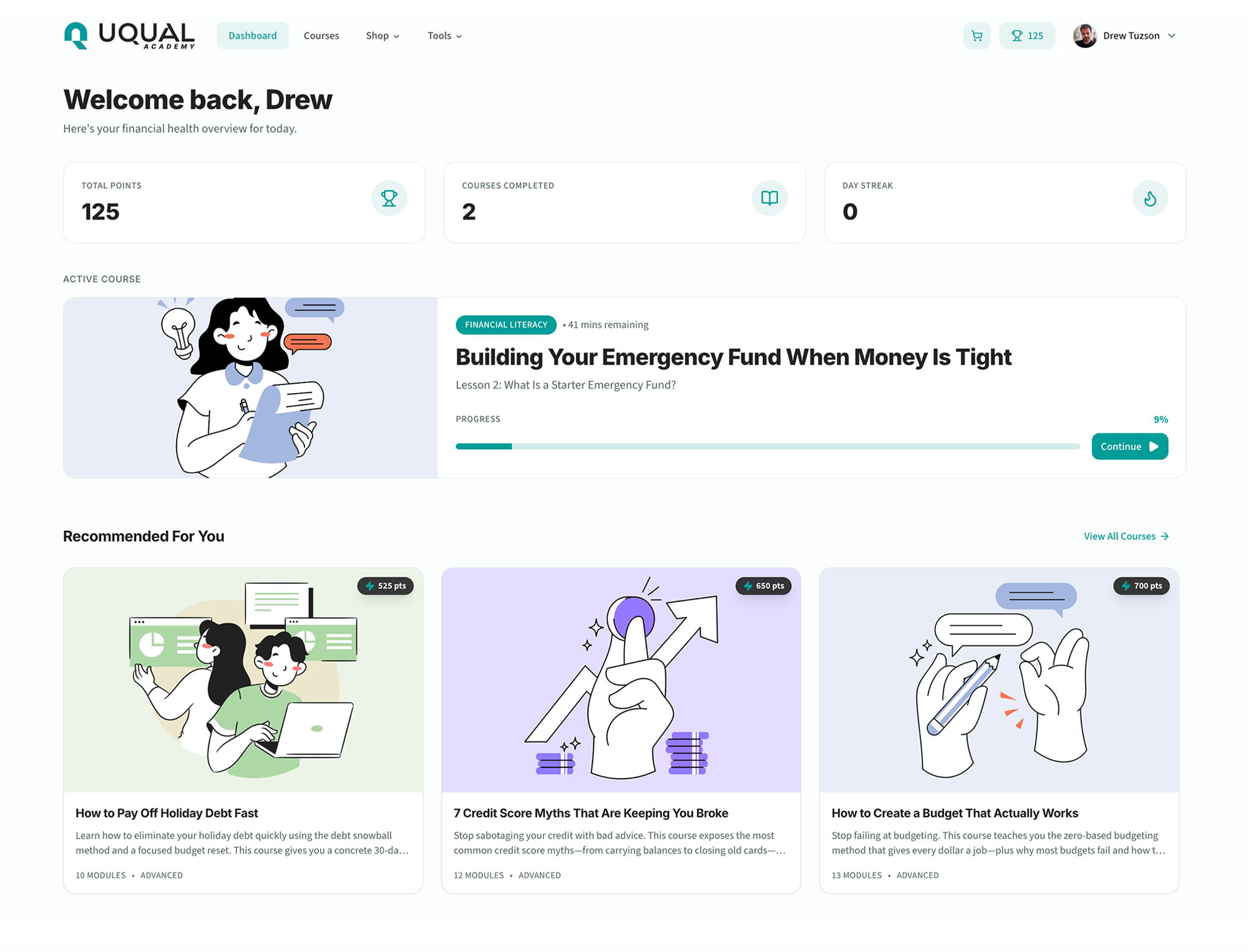
Start by checking your current readiness across all four pillars on our Mortgage Readiness Hub or exploring free courses inside UQUAL Academy.
Disclaimer: Mortgage underwriting guidelines, credit score thresholds, lender overlays, and down payment requirements vary by loan program and lender and are subject to change. Always verify your specific eligibility with a licensed mortgage loan originator or a HUD-approved housing counselor.
UQUAL is a loan readiness company. UQUAL is not a credit repair company and does not provide credit repair, debt settlement, legal, or tax guidance, and UQUAL is not a lender.
Frequently Asked Questions
What is the lowest credit score you can have to buy a house in 2026?
Under official federal guidelines in 2026, the lowest credit score for a standard mortgage is 500 through the Federal Housing Administration (FHA) program, which requires a minimum 10% down payment for scores between 500 and 579. With a 580 credit score, you qualify for FHA's 3.5% down payment tier. VA loans have no statutory credit score floor set by the Department of Veterans Affairs, though most VA lenders apply an internal overlay between 580 and 620. Conventional loans backed by Fannie Mae and Freddie Mac require at least a 620 credit score.
Can I buy a house with a 580 credit score?
Yes. A 580 middle mortgage FICO score meets the official HUD threshold for an FHA loan with a 3.5% minimum down payment, and also satisfies the credit score requirement at many VA-approved lenders for eligible veterans and active-duty service members. To maximize approval odds at a 580 score, borrowers should maintain 12 months of on-time rent and debt payments, keep their back-end debt-to-income ratio below 43%, and hold 1 to 3 months of PITI cash reserves.
How do mortgage lenders calculate my credit score if I have three different scores?
Mortgage lenders pull a tri-merge credit report containing scores from all three nationwide bureaus (Equifax, Experian, and TransUnion) and use your middle score (the median of the three numbers), not the average or highest score. For example, if your mortgage scores are 615, 588, and 572, your official qualifying score is 588. When two co-borrowers apply together on the same loan, the underwriter uses the lower of the two borrowers' middle scores.
What are compensating factors for a low credit score mortgage?
Compensating factors are documented financial strengths defined in HUD Handbook 4000.1 and agency selling guides that offset the risk of a lower credit score or higher debt-to-income ratio. Official compensating factors include verified liquid cash reserves of 3 to 6 months of PITI remaining after closing, minimal housing payment shock (less than a 5% or $100 increase over your verified 12-month rent), zero discretionary revolving debt, significant verified overtime or bonus income not used in qualifying, and strong VA residual income.
Why did I get denied for an FHA loan if my credit score is over 580?
Meeting the 580 credit score minimum does not guarantee mortgage approval because underwriters evaluate four distinct pillars: credit history, debt-to-income ratio (DTI), down payment and cash reserves, and employment/documentation stability. Common reasons for an FHA denial above 580 include a back-end DTI exceeding manual underwriting limits (31%/43%) after a Refer/Eligible finding, a recent 30-day late housing or credit payment within the past 12 months, active credit bureau dispute remarks over $1,000, or unverified cash deposits on bank statements.
Can I get a mortgage with a 600 credit score without paying for credit repair?
Yes. You do not need to pay a credit repair company to qualify for a mortgage at a 600 credit score. First, a 600 score already meets the 580 minimum for an FHA 3.5% down loan and many VA lender guidelines. Second, if you want to reach the 620 threshold for a conventional loan or state down payment assistance, you can exercise your free rights under the Fair Credit Reporting Act (FCRA) at AnnualCreditReport.com to correct factual errors yourself while paying down revolving credit card balances below 10% utilization before your statement closing dates.
How does the credit card statement closing date affect my mortgage score?
Credit card issuers report your account balance to Equifax, Experian, and TransUnion once a month on your statement closing date, which occurs roughly three weeks before your payment due date. Even if you pay your card in full every month on the due date, any balance sitting on the card on the statement closing date is reported to the bureaus and used to calculate your utilization ratio. Paying your balance down below 10% three to five days before the statement closing date ensures the lowest balance is reported when your mortgage lender pulls credit.
What is the AZEO method before applying for a mortgage?
AZEO stands for "All Zero Except One." It is a legal revolving balance management strategy where a borrower pays every revolving credit card down to a $0 balance before the monthly statement closing date, except for one major bank credit card that is allowed to report a small balance (typically $10 to $25, or under 3% of its credit limit) before being paid off by the due date. This keeps aggregate credit utilization near 1% while avoiding the small scoring penalty Classic FICO models assign when 100% of revolving accounts report $0.
Should I pay off collection accounts before applying for a low-credit mortgage?
Not without reviewing agency underwriting rules first. Under FHA, Fannie Mae, Freddie Mac, and VA rules, medical collections are excluded from underwriting DTI ratios. For non-medical collections, FHA ignores cumulative balances under $2,000, and Fannie Mae generally does not require collections to be paid off on a 1-unit primary residence approved through Desktop Underwriter. Paying off an old collection unnecessarily can drain the liquid cash you need for down payment and PITI reserves.
How does housing payment shock affect mortgage approval?
Housing payment shock is the percentage increase between your current verified monthly rent (or housing expense) and your proposed new monthly PITI mortgage payment. When a borrower has a credit score between 500 and 620 or requires manual underwriting, underwriters check whether the proposed mortgage payment is substantially higher than what the borrower is used to paying. Keeping payment shock minimal (under a 5% or $100 monthly increase) with 12 months of on-time rent receipts serves as a formal HUD compensating factor.
Can gift funds be used for the down payment on a low-credit FHA loan?
Yes. HUD Handbook 4000.1 allows 100% of the minimum required down payment (both the 3.5% down payment at 580+ and the 10% down payment at 500 to 579) to come from an eligible donor, such as a family member, employer, or approved government/charitable down payment assistance program, documented with a signed gift letter and transfer paper trail. However, gift funds cannot be counted toward the 1 to 3 months of post-closing PITI cash reserves required as a manual underwriting compensating factor; reserves must come from the borrower's own funds.
Where can I get free help preparing my budget and credit for a mortgage?
In addition to UQUAL's free 4-Pillar Mortgage Readiness Score Calculator and UQUAL Academy courses, you can connect with a free or low-cost HUD-approved housing counselor through the Consumer Financial Protection Bureau's official directory at consumerfinance.gov/find-a-housing-counselor/ and pull your official three-bureau credit reports for free at AnnualCreditReport.com.
Drew Tuzson
UQUAL Technology and Operations
Drew Tuzson supports UQUAL's technology, operations, and content systems. His UQUAL work focuses on turning mortgage-readiness strategy into clear workflows, trustworthy educational content, and measurable execution systems.
Topics
Interactive Diagnostic Tools
Test Your Numbers Against 2026 Agency Underwriting Rules
Use UQUAL's free calculators and underwriting hubs to evaluate your 4-pillar readiness score, Front-End and Back-End DTI ratios, and student loan IDR documentation before authorizing a hard credit pull.
4-Pillar Mortgage Readiness Score Calculator
Grade your Credit, DTI, Down Payment & Reserves, and Documentation readiness on a 0 to 100 scale.
Interactive Mortgage DTI & Debt Tradeoff Calculator
Compare your PITI and total DTI against FHA, Conventional, VA, and USDA rules and simulate paying off debt vs. saving cash.
Student Loan IDR & Mortgage DTI Hub
See how Fannie Mae, Freddie Mac, FHA (0.5% rule), and VA (5% / 12 rule) treat $0 IDR student loan payments.
Request a mortgage readiness review
UQUAL can review your readiness signals and help identify a practical next step before you apply.
2026 Underwriting Reference Mesh
Core Loan Readiness Hubs & Flagship Underwriting Guides
Explore UQUAL's canonical pillar hubs and agency rulebook guides covering credit tiers, manual underwriting, collections, waiting periods, self-employed income, and bank statement seasoning.